
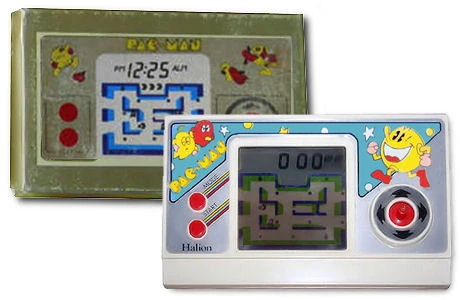

A 1982 Pac-Man handheld game by Halion.
Electronic handheld games, also referred to as handheld LCD games, are dedicated handheld game systems with built-in games. Many Pac-Man handhelds of this variety have been released, starting as early as 1981.
Overview[]
Originating in the late 1970s, electronic handheld games are often based on primitive, calculator-like technology. They were typically in black-and-white, but were occasionally in color. Some systems from the 2010s onward use more advanced technology, cloning console hardware such as the NES/Famicom or Sega Mega Drive/Genesis.
It is difficult to determine which Pac-Man handhelds were licensed/authorized by Namco (or any related parties), especially ones released in the 1980s. This is most apparent with consoles by Epoch, who had a strange mixture of licensed and unlicensed releases. There are also instances where a console was officially licensed in one country, but were seemingly released without license in other territories. Any handhelds where the licensing is unclear are marked as "possibly unlicensed?" in the table(s) below.
Original games[]
Games which were exclusively distributed as proprietary handhelds, and never appeared anywhere else.
| Name | Year | Manufacturer | Information |
|---|---|---|---|
| PacMan2/HungryPac | 1981 | Entex | Also released as a "Select-A-Game" cartridge. Originally produced unofficially, but was briefly granted an official license as part of a court agreement. |
| Pak Pak Man/Epoch-Man | 1981 | Epoch | Also released under many alternate names. Some versions appear to be licensed; the North American release was seemingly licensed as part of a court agreement. |
| Tomy Watchman: Monster Hero | 1982 | Tomy | A wristwatch with a LCD screen. Was later distributed with official Pac-Man branding (see "Ports" section below). |
| PakPak Land | 1984 | Epoch | The same game as Pak Pak Man, but is in a book-shaped plastic case with a storybook inside. Possibly unlicensed? |
| Pac Pac Doraemon | 1989 | Epoch | Modified version of Pak Pak Man featuring Doraemon. Possibly unlicensed? |
| Pac-Junior | 1997 | Bandai | |
| PACit | 1999 | Namco/Sega | A game for the Sega Dreamcast VMU, downloadable via the Dreamcast version of Namco Museum. |
| Li'l Pac-Man | 2000 | Playskool | |
| Pac-Man Tamagotchi | 2020 | Bandai | |
| Monopoly Arcade: Pac-Man | 2020 | Hasbro | A Pac-Man-themed take on Monopoly. While it is mainly just a board game, it comes with a handheld Pac-Man machine, featuring gameplay very similar to Basic Fun's Pac-Man ports. |
Ports[]
Conversions of already existing Pac-Man games.
| Name | Year | Manufacturer | Information |
|---|---|---|---|
| Tomy LSI Game Pac-Man/Puckman | 1981 | Tomy | Possibly the first handheld released, and the only 1980s model to be released with actual Pac-Man branding in Japan. |
| Pac-Man/Super Puck Monster | 1981 | Coleco (US) Gakken (JP) |
Tabletop arcade machine. Features three game modes, including a two player co-op mode and an additional game titled "Eat & Run". |
| Pac-Man | 1982 | Cresta, Ectron, Halion | Two designs were produced. Gameplay is very similar to the Tomy LSI Game. Similarly designed to Nintendo's Game & Watch series; some models even say "Game & Time" below the joystick. |
| Puck Monster/Pac Man | 1982 | Gakken (JP) Futuretronics (AU) CGL (EU) |
Two designs were produced. Some versions are licensed. |
| Ms. Pac-Man | 1983 | Coleco | Tabletop arcade machine. Like Coleco's Pac-Man tabletop, it features a two player co-op mode. |
| Pac-Man (Double Wide Screen) |
1984 | Orlitronic/Tiger | Split across two screens in a clamshell case, similar to some Game & Watch units and the Nintendo DS. Uses artwork from the Hanna-Barbera cartoon. |
| Pac-Man (Large Screen) |
1984 | Orlitronic/Tiger | Only features one screen. Uses artwork from the Hanna-Barbera cartoon. |
| Ms. Pac-Man | 1984 | Orlitronic/Tiger | Features a unique "shaped" plastic case featuring Ms. Pac-Man laying on a heart. |
| Pac-Man Game Watch (version 1) |
198? | Nelsonic | Two designs were produced. A wristwatch with a LCD screen. A modified version of the aforementioned Tomy Watchman: Monster Hero with different graphics. Unlike other ports, Pac-Man has his arms and legs in-game. |
| Pac-Man Game Watch (version 2) |
198? | Nelsonic | A wristwatch with a LCD screen. Plays almost identically to Tomy LSI Game Pac-Man. |
| Super Pac-Man | 198? | Grandstand, Halion | Despite the branding, the game is identical to the "Cresta" port of Pac-Man and not Super Pac-Man. This unit seems particularly rare, with very few copies being found. |
| Pac-Man (MGA, version 1) |
1992 | MGA | Two designs were produced. A loose adaption of the arcade game. |
| Ms. Pac-Man (MGA, version 1) |
1992 | MGA | Three designs were produced. A loose adaption of the arcade game. Unlike other ports, Ms. Pac-Man has her arms and legs in-game. |
| Pac-Land | 1992 | Namco/Systema | A rather loose adaption. Pac-Man must walk across platforms in order to reach Ms. Pac-Man. It plays similarly to the Super Mario Bros. Game & Watch. |
| Pac-Land (Giocatraduci) |
1995 | Unknown | A cartridge for the Giocatraduci system (which is based on LCD technology). It shares some similarities to the 1992 Pac-Land handheld in gameplay, but it is not identical. |
| Pac-Man (MGA, version 2) |
1995 | MGA | A closer adaption of the arcade game compared to MGA's first version. A ridiculously high amount of different designs were produced, including standard handhelds, keychains, and even a version built into a pen (Pen Arcade). |
| Pac-Man (Color FX/Color FX II) |
199? | MGA | Colorized versions of MGA's second port of Pac-Man. |
| Ms. Pac-Man (MGA, version 2) |
199? | MGA | Practically the same as MGA's second Pac-Man port, but with Ms. Pac-Man's first maze instead. Several different designs were produced. |
| Ms. Pac-Man (Color FX/Color FX II) |
199? | MGA | Colorized versions of MGA's second port of Ms. Pac-Man. |
| Pac-Man | 2000 | Masudaya Corporation, Epoch | Uses a light sensor to project the screen onto a mirror. |
| Pac-Man Colour Handheld Game | 200? | Zeon Tech | Uses a light sensor to project the screen onto a mirror. An alternate, seemingly unauthorized version was produced (by Zeon Tech themselves) titled "Arcade Classic", which features Pac-Man wearing a cowboy hat. |
| Arcade Classics: Pac-Man (#1) |
2016 | Basic Fun | Tabletop arcade machine with a monochrome screen. Features the Eat & Run mode from the Pac-Man Coleco tabletop. |
| Arcade Classics: Pac-Man (#7) |
2017 | Basic Fun | Colorized version of Basic Fun's Arcade Classics: Pac-Man (#1). |
| Arcade Classics: Ms. Pac-Man (not numbered) |
2018 | Basic Fun | Tabletop arcade machine with a color screen. |
| Pac-Man Desktop Arcade/Pac-Man Game Keyring | 2020 | Fizz Creations | Seemingly rebranded versions of Basic Fun's Arcade Classics: Pac-Man (#1). |
Console clone hardware[]
Handhelds which are based on more standard video game hardware - such as the Atari 2600, Famicom/NES, or Sega Genesis - rather than the crude technology used in the other devices.
| Name | Year | Manufacturer | Information |
|---|---|---|---|
| Sega Genesis Ultimate Portable Game Player (2017) |
2017 | AtGames | Features 85 built-in games, including Pac-Panic (European version of Pac-Attack). |
| Atari Flashback Portable (2017) |
2017 | AtGames | Features 70 built-in games, including Pac-Man 4K (a homebrew Atari 2600 port of Pac-Man). |
| Tiny Arcade - Pac-Man | 2017 | World's Smallest | |
| Tiny Arcade - Ms. Pac-Man | 2017 | World's Smallest | |
| Pac-Man Micro Player | 2018 | My Arcade | Tabletop arcade machine; based on Famiclone hardware. |
| Pac-Man Pocket Player | 2018 | My Arcade | Features Pac-Man, Pac-Attack, and Pac-Mania; based on Sega Genesis clone hardware. |
| Arcade Classics: Ms. Pac-Man (#11) |
2018 | Basic Fun | |
| Ms. Pac-Man Micro Player | 2018 | My Arcade | Tabletop arcade machine; based on Famiclone hardware. |
| Ms. Pac-Man Pocket Player | 2018 | My Arcade | Features Ms. Pac-Man, Mappy, and Sky Kid; based on Famiclone hardware. |
| Tiny Arcade - Ms. Pac-Man/Galaga | 2018 | World's Smallest | Based on the "Class of 1981" anniversary machine. The code to unlock Pac-Man is intact, but it unlocks Dig Dug instead. |
| Micro Arcade - Pac-Man | 2019 | World's Smallest | |
| Tiny Arcade - Pac-Man Tabletop Edition | 2019 | World's Smallest | |
| Stranger Things Palace Arcade | 2019 | Hasbro | Features 20 built-in games, including Pac-Man, Galaxian, Galaga, and Dig Dug. |
| Arcade Classics: Pac-Man (#14, #20) |
2019 | Basic Fun | |
| Atari Retro Handheld Console - Pac-Man Edition | 2020 | Blaze | Features 60 built-in games, including the Atari 2600 version of Pac-Man. |
| Pac-Man Micro Player - 40th Anniversary Edition | 2020 | My Arcade | Based on Sega Genesis clone hardware. Compared to the non-40th model, it is gold instead of yellow, and the side artwork is a lenticular print. |
| Micro Arcade - Ms. Pac-Man | 2020 | World's Smallest | |
| Pac-Man tilt | 2020 | World's Smallest | A port of the original Pac-Man controlled by tilting the console itself; not to be confused with the 2011 game. |
| Tiny Arcade - Hello Kitty ♥ Pac-Man | 2020 | World's Smallest | Port of the iOS/Android game. |
| Tiny Arcade - Atari 2600 | 2021 | World's Smallest | Features 10 built-in games, including a port of the Atari 2600 version of Pac-Man. |
| Pac-Man in a Tin | 2022 | Fizz Creations | Based on Famiclone hardware; seemingly uses a "VT03" (16-bit colors) hack of the Famicom/NES port. |
| Pac-Man Micro Player Pro | 2023 | My Arcade | Tabletop arcade machine; based on Sega Genesis clone hardware. |
| Ms. Pac-Man Micro Player Pro | 2023 | My Arcade | Tabletop arcade machine; based on Sega Genesis clone hardware. |
| Pac-Man Pocket Player Pro | 2023 | My Arcade | Based on Sega Genesis clone hardware. |
| Ms. Pac-Man Pocket Player Pro | 2023 | My Arcade | Based on Sega Genesis clone hardware. |
Trivia[]
- Long before the formation of Bandai Namco Entertainment, Bandai released a bootleg Pac-Man handheld titled Packri Monster (cheekily stylized as "PACKri MONster"). Its release led to a lawsuit between Bandai and Bally Midway.
- AtGames has released several other Pac-Man handhelds not listed on this page; in reality, these are bootleg products released after their contract with Bandai Namco had been terminated, which AtGames intentionally rushed out amidst their lawsuit with them.
- Unlike the originally-unauthorized "Bandai Namco Arcade Blast!" Plug & Play system, the handheld consoles were not granted license following the Namco-AtGames lawsuit's settlement.
Gallery[]
Original games[]


Pac-Man ports[]


![Pac-Man (MGA, version 2) box [design 1]](/wiki/File:Mga-pacman-ver2-box.png "Mga-pacman-ver2-box.png (1.04 MB)")
![Pac-Man (MGA, version 2) box front [design 2]](/wiki/File:Mga-pacman-ver2-box-a.png "Mga-pacman-ver2-box-a.png (9.54 MB)")
![Pac-Man (MGA, version 2) box back [design 2]](/wiki/File:Mga-pacman-ver2-box-a2.png "Mga-pacman-ver2-box-a2.png (7.85 MB)")
![Pac-Man (MGA, version 2) box [design 3]](/wiki/File:Mga-pacman-ver2-box-a3.png "Mga-pacman-ver2-box-a3.png (7.85 MB)")


Ms. Pac-Man ports[]


Other ports[]


Console clone hardware[]

